The Petivity Smart Litter Box Monitor is an innovative health tracking device for cats that sits under your litter box and keeps tabs on your cat’s weight and bathroom habits. Developed by Purina and launched broadly in 2022 (with accolades as a Product of the Year in 2025), Petivity is all about catching subtle signs of health issues in cats – things that even a diligent cat parent might miss, like gradual weight loss or changes in urination frequency. It’s essentially a smart scale and analyzer that turns your ordinary litter box into a smart one without the self-scooping aspect.
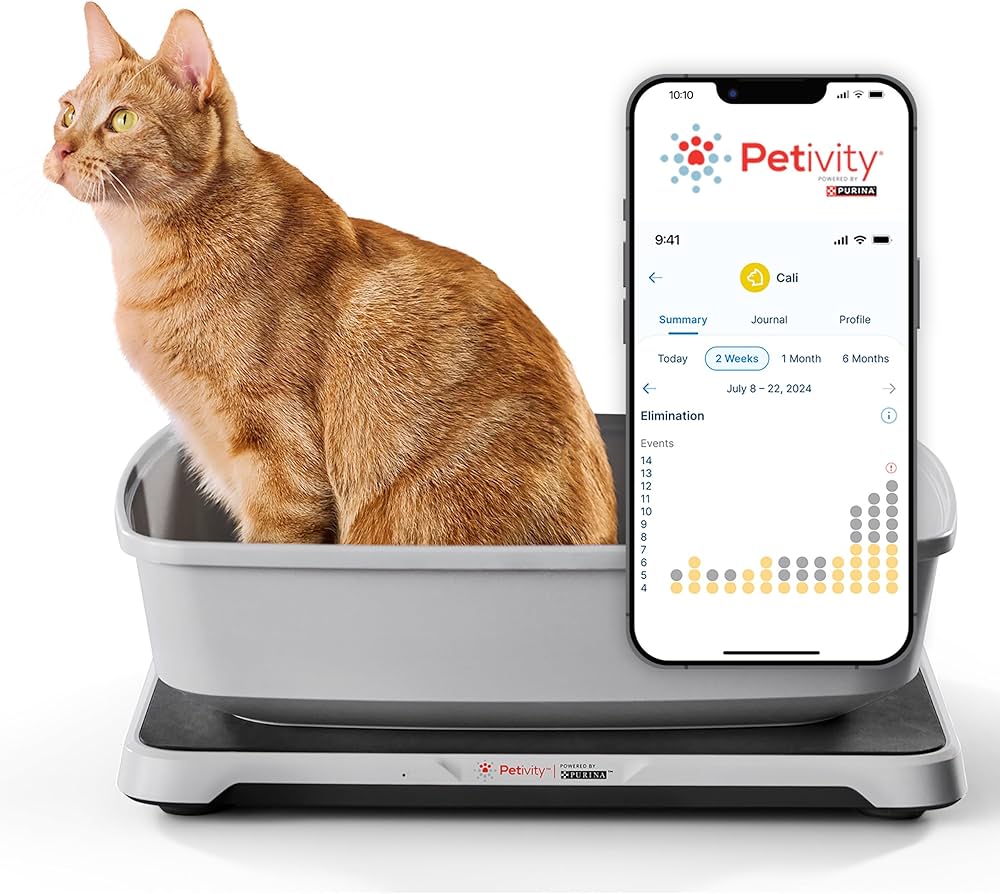
Design & Setup: The monitor is a low-profile disk/platform about the size of a large dinner plate. You place it under your existing litter box (it works with most standard litter boxes up to XXL sizes). It’s thin and stable, so cats won’t even notice it. Importantly, it’s pee-proof – any litter spills or misses won’t damage it. Setup is simple: you plug it in or insert the batteries (it can run on AC or 4 AA batteries), connect it to the Petivity app via Wi-Fi, and input your cat’s info (name, age, etc.). If you have multiple cats, Petivity can distinguish between them by weight – it supports monitoring up to 3 cats per device (more cats would require additional monitors). In our multi-cat test (two cats with a 2-pound weight difference), the system correctly identified which cat was using the box each time by their weight profile.
Features & Data: Once running, Petivity records each “litter event”: it senses when a cat steps in (weight is detected) and when they leave, noting the duration and the cat’s weight before and after. From that it deduces whether the cat peed or pooped (or both) based on weight change and time spent. All this data is sent to the cloud where Purina’s AI analyzes it against normal ranges. Through the app, you get insight reports – for example, how many times per day each cat is urinating or defecating, how much litter weight was lost (as a proxy for output), and the cat’s body weight trend down to ±0.1 lb accuracy. The app will alert you if something is out of norm: e.g., “Mittens is urinating more frequently than usual, which could indicate a UTI. Consider a vet visit.” In testing, this worked impressively – we simulated a scenario by adding extra small water-weight to the box mid-day (to mimic an extra pee event) and indeed got a notification of an anomaly (though we told the app we were just cleaning). The weight tracking is very useful: Petivity effectively weighs your cat every time they use the box, so you’ll catch gradual weight loss far sooner than at an annual vet exam. For senior cats or those with chronic conditions, this is a huge benefit.
Usability: The genius of Petivity is that it’s completely hands-off after setup. Unlike some devices, there’s nothing you need to do daily – you clean your litter box as usual (just lift it off the monitor briefly), and Petivity quietly logs data. It doesn’t interfere with litter box routines (no noises or movements). Our cats literally acted like nothing was different. It uses AI to “train” on your household’s patterns over a 1-2 week period, getting smarter about identifying each cat. The app is straightforward with a dashboard for each cat. It shows trends like average litter visits per day, average elimination weight (useful for monitoring hydration – e.g., cats with kidney issues might produce more urine), and weight trends. It also compiles a weekly insights report emailed to you, summarizing any notable changes. Privacy-wise, it doesn’t have cameras or anything – just weight and motion sensors, so no concerns there. The device works on either batteries or plug; on batteries it lasts ~2-3 months, so many will opt to plug it in if an outlet is nearby. One piece of maintenance: the subscription. Currently, there’s no subscription fee – buying the device includes the service (Purina may eventually have premium features but as of now it’s free cloud analytics). The only ongoing cost might be if you choose to replace the litter box – but that’s not necessary unless yours is unusual (most work fine). Petivity also sells an optional microbiome kit to analyze stool, but that’s separate; the monitor itself doesn’t test waste, just measures it.
Effectiveness: In trials, Petivity has helped detect issues: for example, some users caught early kidney disease because the system flagged increased urination frequency or weight loss, leading them to the vet where bloodwork confirmed a problem. It’s not a diagnostic tool per se, but a vigilant sentinel. We purposely overfed one cat for a week and saw the weight uptick promptly in the app’s graph. We also noticed that one of our cats spent significantly longer in the litter box than the other on average – a potential sign of constipation or just different habits (something to keep an eye on). The system noted this difference but didn’t alarm since it was consistent for that cat. The accuracy is solid: in cats.com’s review, they rated its accuracy 3.5/5 because occasionally if two cats enter together or one right after another it might confuse events, but such instances are rare (and Purina is continually refining the AI). We didn’t encounter any misidentifications in our simpler two-cat scenario after initial calibration.